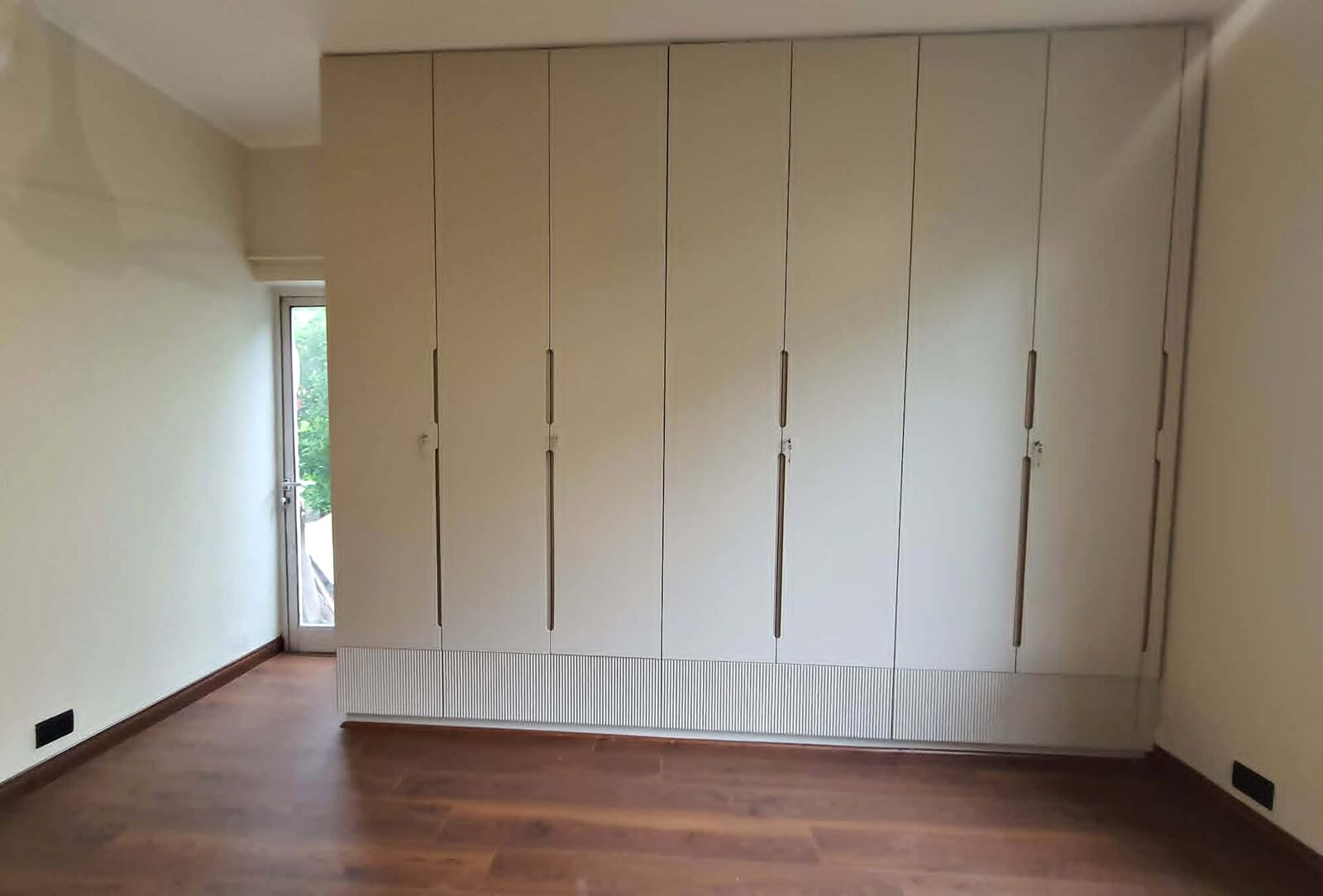
Custom vs Modular Wardrobes — What Nobody Tells You
The real difference is not the price. It is what happens in year five — and what you can never change after day one.
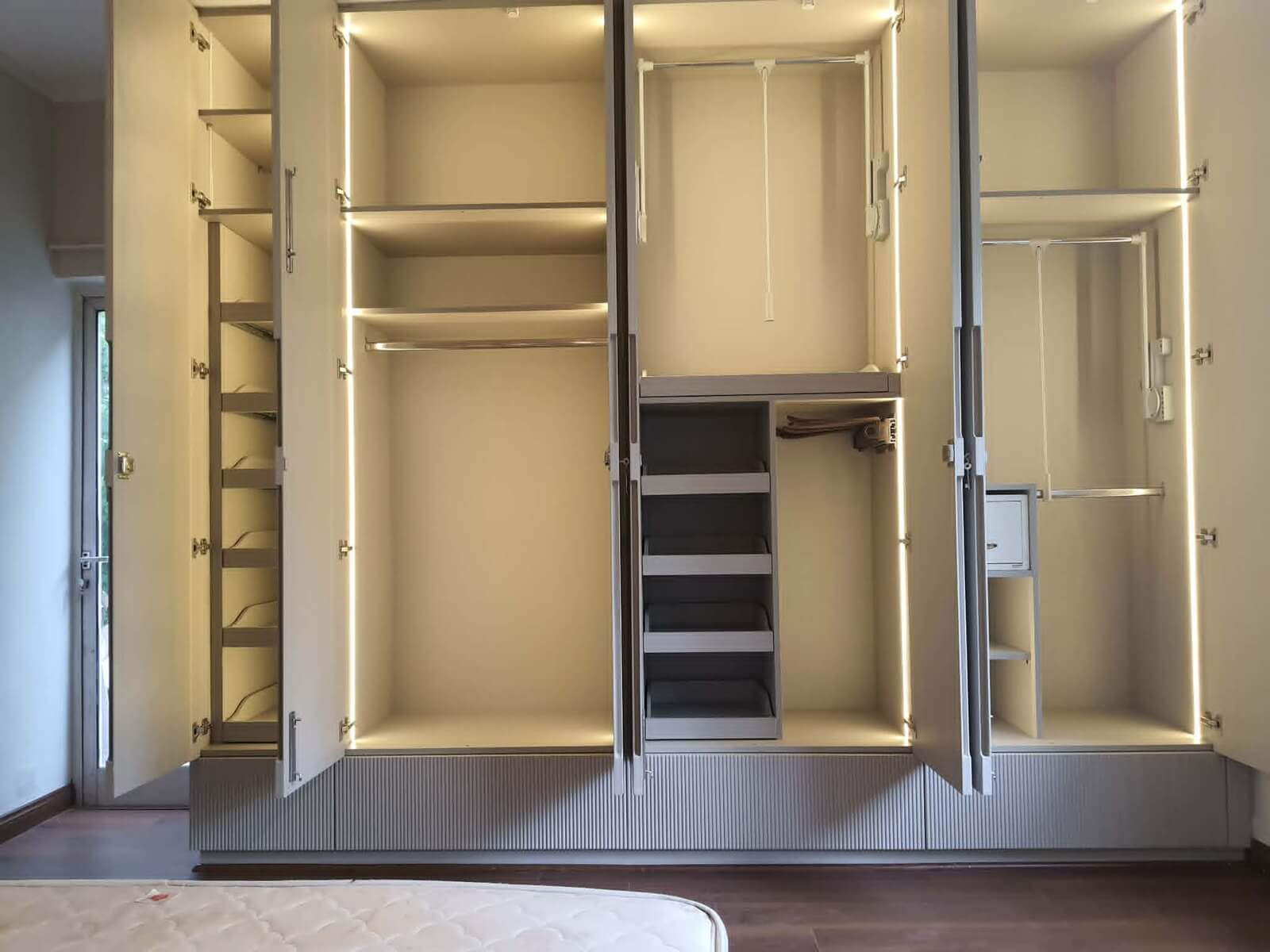
A modular wardrobe is assembled from pre-made boxes in standard widths. A custom wardrobe is designed from scratch — for a specific wall, a specific person, and a specific way of living.
Both are factory-built. Both arrive flat-packed. Both get assembled on site.
The difference is not in how they are made. It is in how much of the thinking happened before the first board was cut.
What does modular actually mean?
Modular means the wardrobe is built from fixed-width units — typically 450, 600, or 900 mm — manufactured in bulk. You choose units that add up closest to your wall width.
The internal layouts are pre-configured templates. You pick from a set of finishes and a shade card. The units ship flat-packed and a crew assembles them against your wall.
What modular genuinely does well:
- Speed — measured, ordered, installed in two to three weeks
- Predictability — the finish is consistent because it is factory-produced
- The price is the price — no surprises
Where modular hits a wall:
A 3,200 mm wall fitted with 600 mm modules leaves a 200 mm gap. That gap gets a filler panel — dead space that stores nothing.
Ceiling heights, floor irregularities, skirting, electrical points, AC vents, adjacent door swings — modules work around all of these rather than integrating with them. The furniture adjusts to the room. The room does not get furniture that was made for it.
And the internal layout? It comes from a template. Your shelves are the same height as everybody else's shelves. Your drawer widths are decided by the basket sizes the brand stocks — not by what you actually own.
What does custom actually mean?
Custom means someone sat with you before a single board was ordered.
They looked at the space — every millimetre. Wall width. Ceiling height. Floor level. Electrical points. Plumbing. AC outlets. Door swings. Adjacent furniture. The skirting that juts out 12 mm on one side.
Then they looked at you — what you own, what you wear daily, what is seasonal, what hangs, what folds, what needs to be visible, and what should disappear.
The wardrobe is designed to the last half inch. If there is a 3-inch gap in the corner, it does not get a filler panel. It becomes a 3-inch sliding pocket with hooks inside — a pull-out that holds belts, scarves, or dupattas. Every centimetre earns its place.
The look and feel match the room — the existing furniture, the colours, the design scheme, the architecture. The wardrobe does not sit against the wall. It becomes part of it.
Does custom take longer? It takes the time precision requires. Four to six weeks from approved design to installed wardrobe. That is not a limitation — it is what happens when every compartment, every shelf height, every drawer width is decided by what your life needs, not by what the factory had in stock.
The five things modular cannot do
1 · Fill every millimetre. Standard-width modules leave gaps. A custom wardrobe fills the wall corner to corner, floor to ceiling. No filler panels. No dead space.
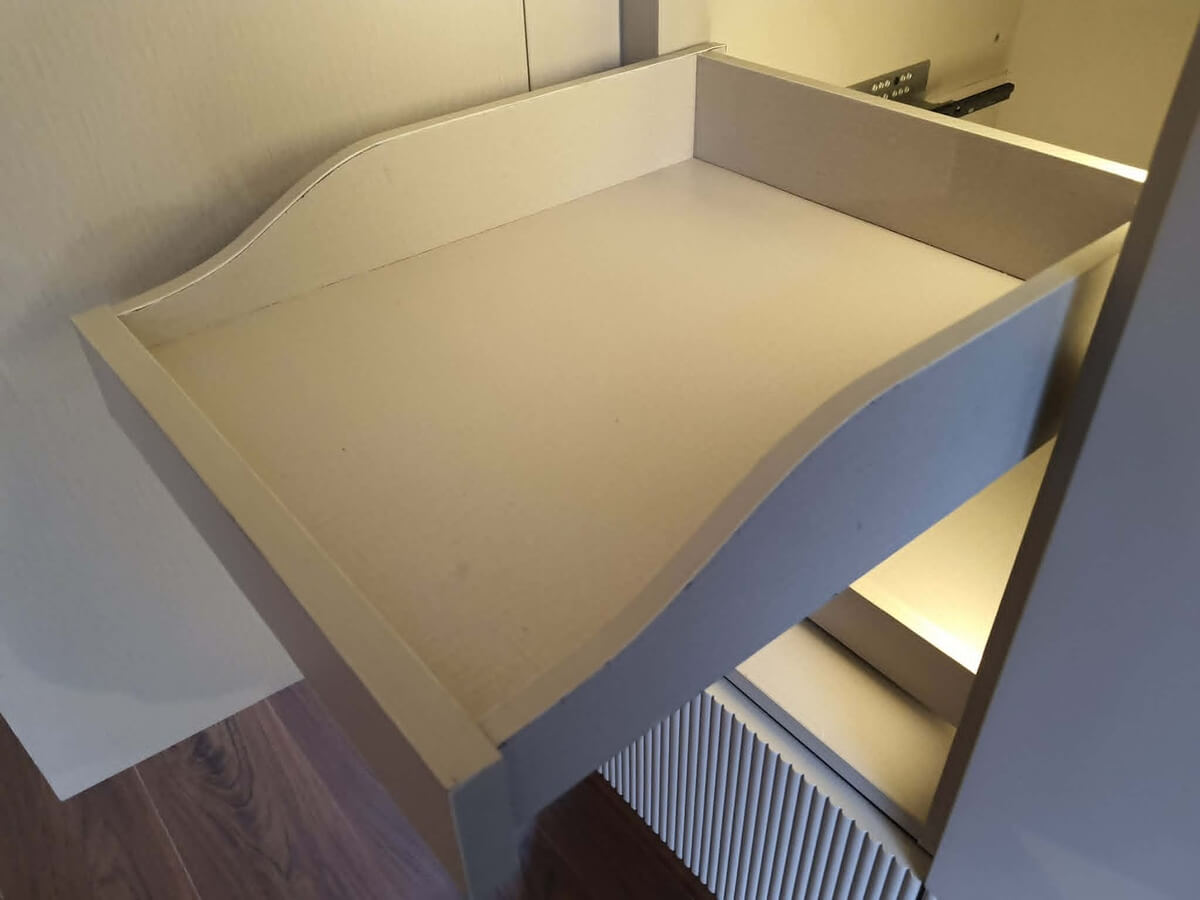
2 · Design around what you own. Sarees stored flat — not folded on a 12-inch shelf designed for T-shirts. Bags upright in compartments sized for them. Shoes in pull-outs that match your collection, not a generic shoe rack.
3 · Let you choose the structural board. In modular, you get whatever board the brand uses — often HDMR as a structural material. In custom, you specify the board, verify the cross-section, and visit the factory where it is being built.
4 · Match the room's architecture. A custom wardrobe can integrate with wall panelling, match the door finish, align with ceiling moulding. Modular sits against the wall. Custom becomes the wall.
5 · Move with you. A factory-built custom wardrobe is assembled by a skilled team that knows exactly how it was constructed. If you relocate, the same team can disassemble, transport, and reassemble it in your new home.
When modular is the right answer
If your builder just handed over the flat and you are moving in three weeks — a modular wardrobe from a reputed brand will be measured, delivered, and installed before you unpack.
If you have a standard wall with no complications, no strong opinions about the internal layout, and need something functional without a conversation — modular is the right choice.
There is no shame in choosing modular when the situation calls for it. The mistake is choosing modular expecting custom-level fit — or choosing custom expecting modular-level speed.
What happens in year five?
Modular brands offer warranties — typically one to five years on manufacturing defects.
After that, the specific finish you chose may no longer be in the shade card. The internal accessories may be revised. Getting an exact match for an extension or replacement becomes approximation.
A custom wardrobe built in a dedicated factory does not depend on a product catalogue. The same person who designed it can repair, modify, or extend it five years later — because the construction method has not changed. There is no discontinued model. There is a designer and manufacturer who knows exactly how your wardrobe was built.
Read next
Frequently Asked Questions
Is a custom wardrobe better than modular?
Is custom furniture more expensive than modular in Gurgaon?
How long does a custom wardrobe take?
Can modular wardrobes be customised?
What lasts longer — custom or modular?
Can a custom wardrobe be moved to a new home?
What is the difference between customised and custom?
Should I get a modular or custom kitchen?
If this raised more questions than it answered — that's the beginning of a great conversation. Reach out with your questions or list of topics you'd like covered next!
Talk to Himani on WhatsApp