Kitchen Storage for Indian Cooking — What No Modular Catalogue Covers
Your cooking involves bulk quantities, heavy cookware, and a workflow that no standard module was designed for. Here is what the storage actually needs.
Indian households can have very different storage and cooking requirements from the assumptions built into a standard kitchen system. The quantities are different. The cookware is different. The workflow is different. The storage requirements are fundamentally different.
And yet most kitchen storage — modular or otherwise — is designed around a set of assumptions that do not match what actually happens in an Indian kitchen.
The bulk-storage problem
Indian households buy rice in 5-10 kg bags. Oil in 5-litre tins. Dal by the kilo. Spices in quantities that a European-designed spice rack was never built for.
Standard pantry modules hold packaged items in neat rows. Indian bulk provisions do not come in neat rows. They come in bags, tins, and containers that are heavy, oddly shaped, and need to be accessible without lifting and restacking.
The solution is a dedicated larder — a tall, full-height storage unit designed specifically for bulk provisions. Rice and dal on pull-out shelves at waist height. Oil tins in deep base compartments. Dry fruits and supplements in upper zones. The larder can hold backup stock, freeing prime everyday storage for items actually used during cooking but easily reachable when restocking.
Without a larder, bulk provisions colonise the everyday cabinets. Daily-use items get pushed deeper. The kitchen feels cluttered even when it is technically full.
The cookware problem
A kadhai. A pressure cooker. A large stockpot. A set of tawas. Baking trays. Festive serving pieces for twenty.
These are heavy, wide, deep, and oddly shaped. Standard base cabinets hold them — but stacked on top of each other, tilted sideways, or shoved into corners where pulling one out means moving three.
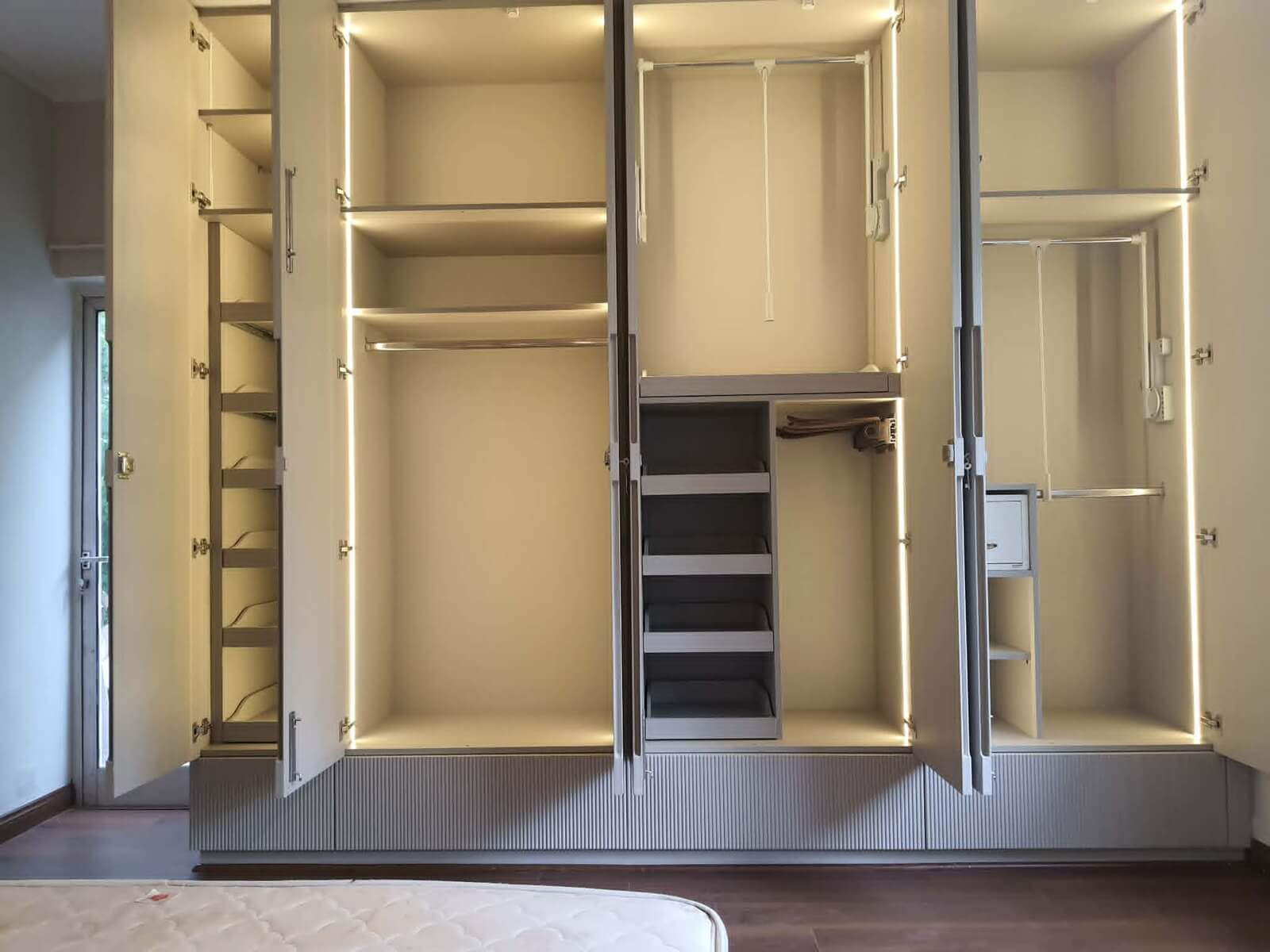
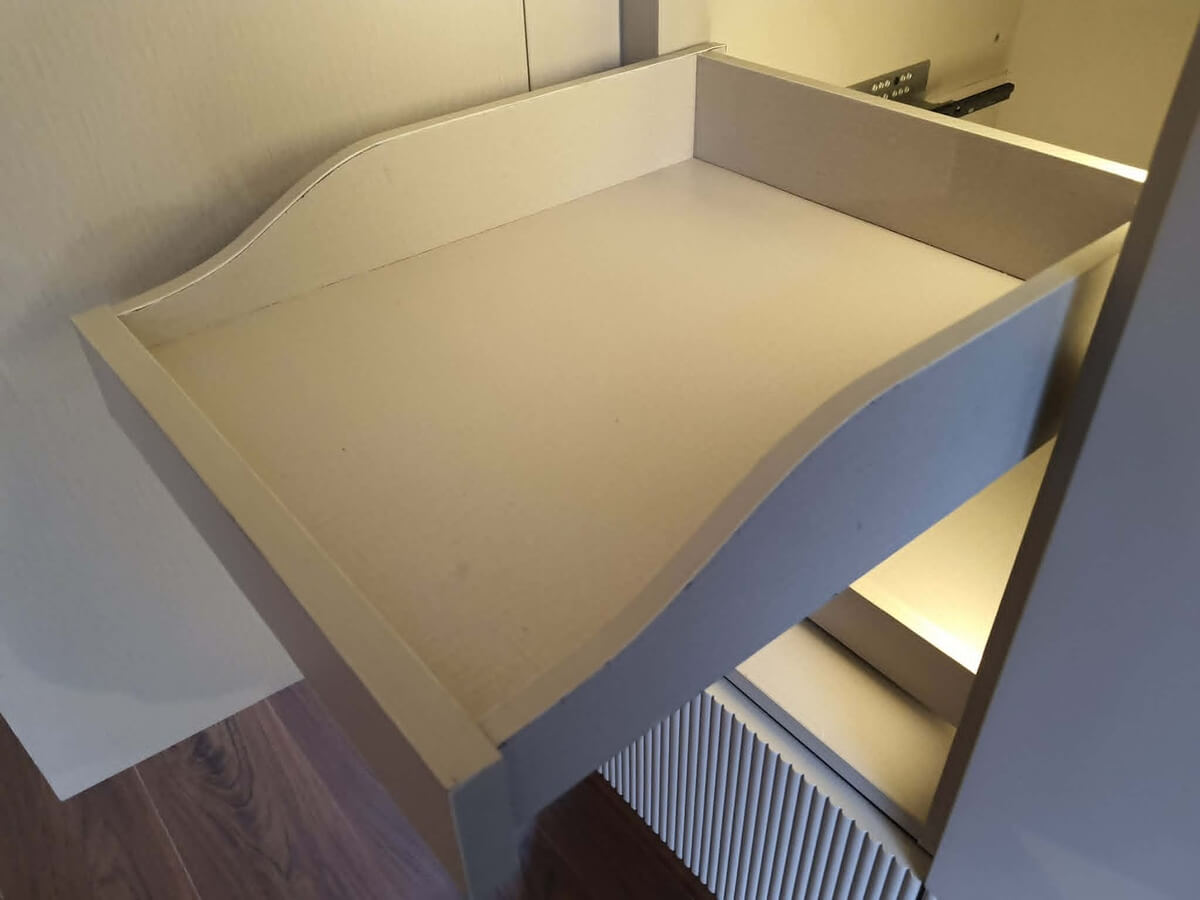
The solution is pull-out storage designed around the actual cookware dimensions. Measure the largest kadhai before designing the cabinet. Vertical dividers for baking trays and cutting boards. Deep pull-outs for pressure cookers where each piece has its own slot.
The spice problem
Indian cooking uses spices at the point of use — during tempering, during seasoning, during finishing. Mustard seeds, cumin, curry leaves, chilli, turmeric — needed in the same second, not after a walk across the kitchen.
A spice drawer within arm's reach of the burner — not in a separate pantry, not in a decorative rack on the opposite wall. The drawer should hold everyday spices flat, visible at a glance, each in its own compartment. Bulk spice refills live in the larder. Daily quantities live at the stove.
Reach hierarchy — the principle that organises everything
Not everything deserves the same access:
- Daily-use: easiest reach — eye level, arm height. The kadhai, the everyday plates, the cutting board, the oil, the spices.
- Weekly-use: secondary reach. The mixer, the baking tray, the serving bowls for weekend cooking.
- Seasonal and festive: upper cabinets or larder. The biryani pot, the chaat plates, the Diwali serving set.
- Bulk stock: dedicated larder compartments. The backup rice, the extra oil, the dry-fruit inventory.
When everything is given equal access, the kitchen feels chaotic — because the kadhai and the biryani pot are competing for the same shelf. Reach hierarchy solves this without adding more cabinets.
The appliance problem
A stand mixer. A food processor. A coffee machine. A toaster. An air fryer. A juicer.
Many are used less frequently than the appliances and ingredients that need to remain on the primary work surface. All of them occupy permanent counter space — leaving the cook with nowhere to actually work.
The solution: dedicated appliance storage — a garage-style pull-out, a tall unit with retractable shelves, or deep base cabinets specifically sized for each appliance. The counter stays clear for the work that happens every day.
The wet-dry separation problem
Indian cooking involves simultaneous wet work (washing, rinsing, soaking) and dry work (cutting, rolling, plating, assembling). When these zones share the same counter, everything gets damp. Flour gets wet. The chopping board is perpetually wiped.
The solution is zoning — the wet zone (sink, rinsing, soaking) physically or spatially separated from the dry zone (cutting, rolling, plating). The method depends on the room — counter positioning, a partition, a workflow change. The principle is consistent: wet and dry should not interfere.
What this storage looks like when it works
You open the kitchen in the morning. The tea things are within one-hand reach. The tiffin supplies are in a dedicated zone. The spices are at the stove. The kadhai slides out without lifting anything. The counter is clear.
The storage is invisible. You do not think about it. You just cook.
Read next
Frequently Asked Questions
How should an Indian kitchen be organised for storage?
What is a kitchen larder?
How do I store heavy Indian cookware properly?
Where should kitchen spices be stored?
What is reach hierarchy in kitchen storage?
How do I separate wet and dry zones in a kitchen?
If this raised more questions than it answered — that's the beginning of a great conversation. Reach out with your questions or list of topics you'd like covered next!
Talk to Himani on WhatsApp