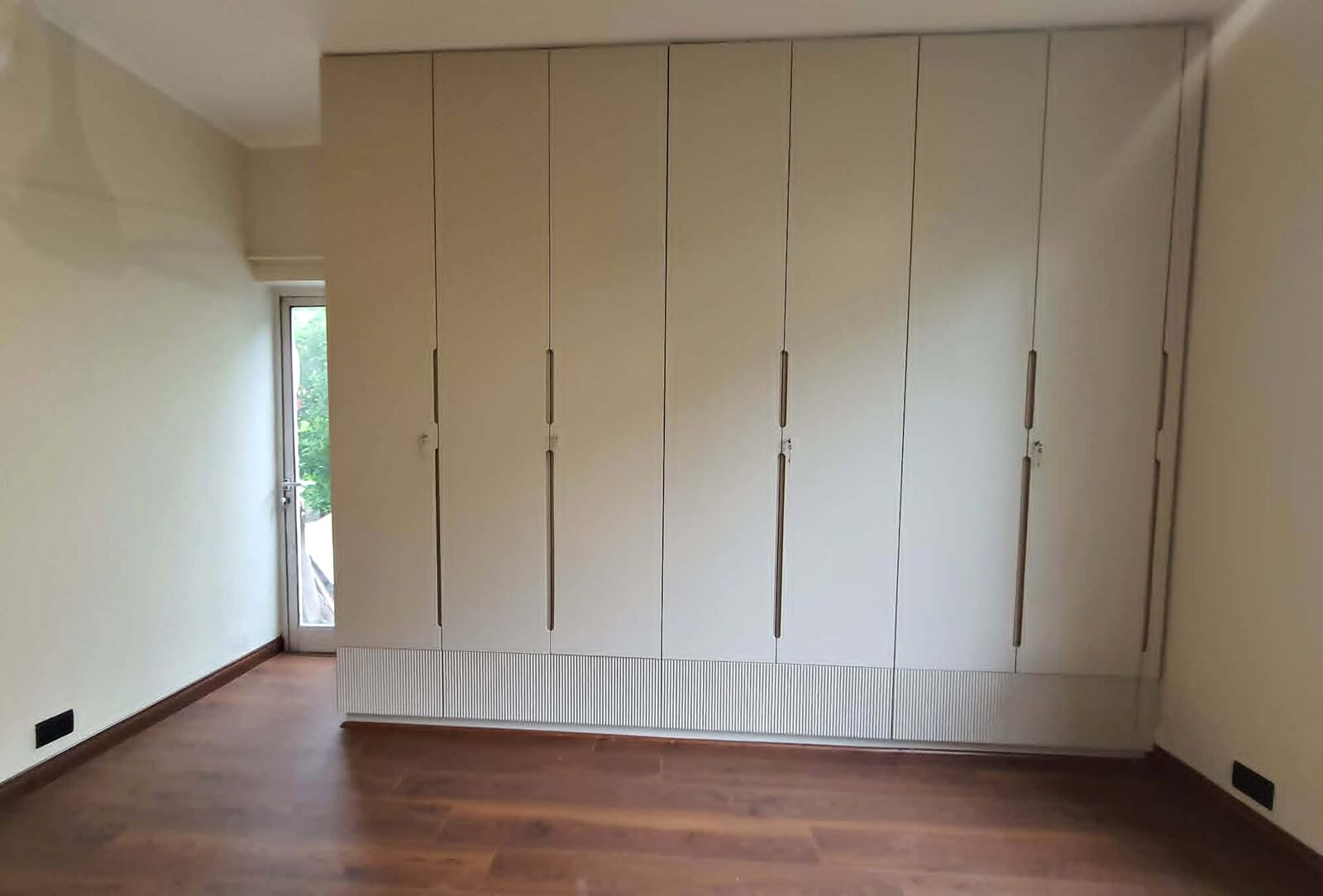
Interior Designer or Furniture Designer in Gurgaon — How to Know Which One You Need
One designs the theme of your room — walls, ceilings, lighting, layout. The other goes deep into the furniture itself — scale, storage, construction, every drawer and shelf. The lens is completely different.
You type "interior designer Gurgaon" into Google — or ask a friend who recently furnished their apartment. Both paths lead to the same problem: there are at least three very different professionals behind that one search, and hiring the wrong one costs you months, money, and a result that looks finished but does not function.
Here is the distinction nobody explains clearly enough.
What does an interior designer actually do?
An interior designer plans the entire environment of your home — from the floor up.
- Space planning — how rooms connect, where walls go, how you move through the apartment
- Electrical and plumbing layout — switch points, water outlets, service lines
- Flooring, wall treatments, ceiling design — material, colour, texture
- Lighting design — ambient, task, accent, integrated ceiling lighting
- Material palette — the overall look, feel, and visual language of the home
- Furniture placement and procurement — sometimes custom-designed, often sourced from vendors
- Coordination — contractors, electricians, plumbers, painters, carpenters, timeline management
An interior designer manages the architecture of the space — everything visible and everything hidden behind the walls that makes the visible part work.
But here is the critical distinction: specifying a wardrobe and designing a wardrobe are not the same scope of work.
An interior designer may specify: "10-foot wardrobe, veneer finish, soft-close hardware."
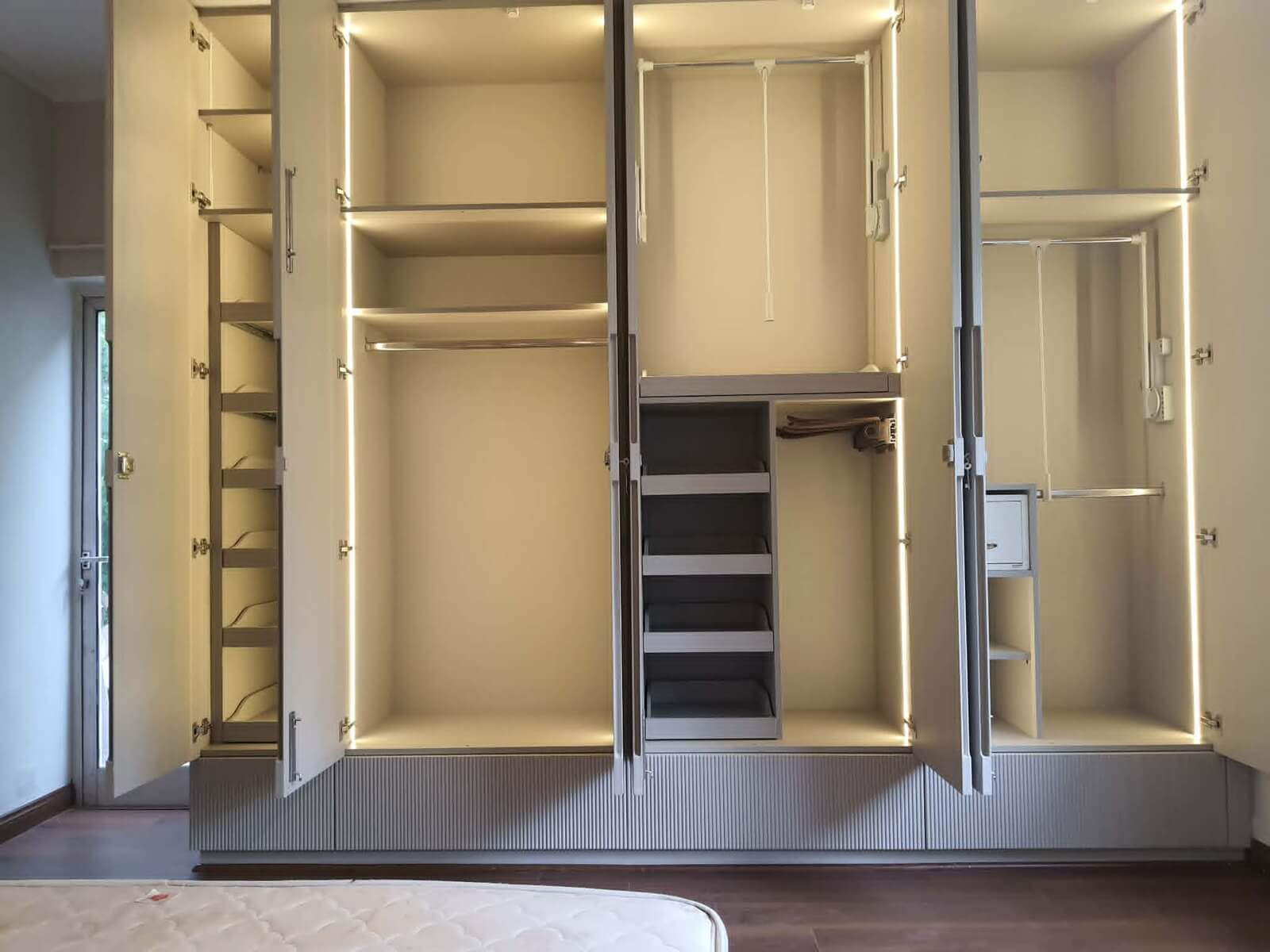
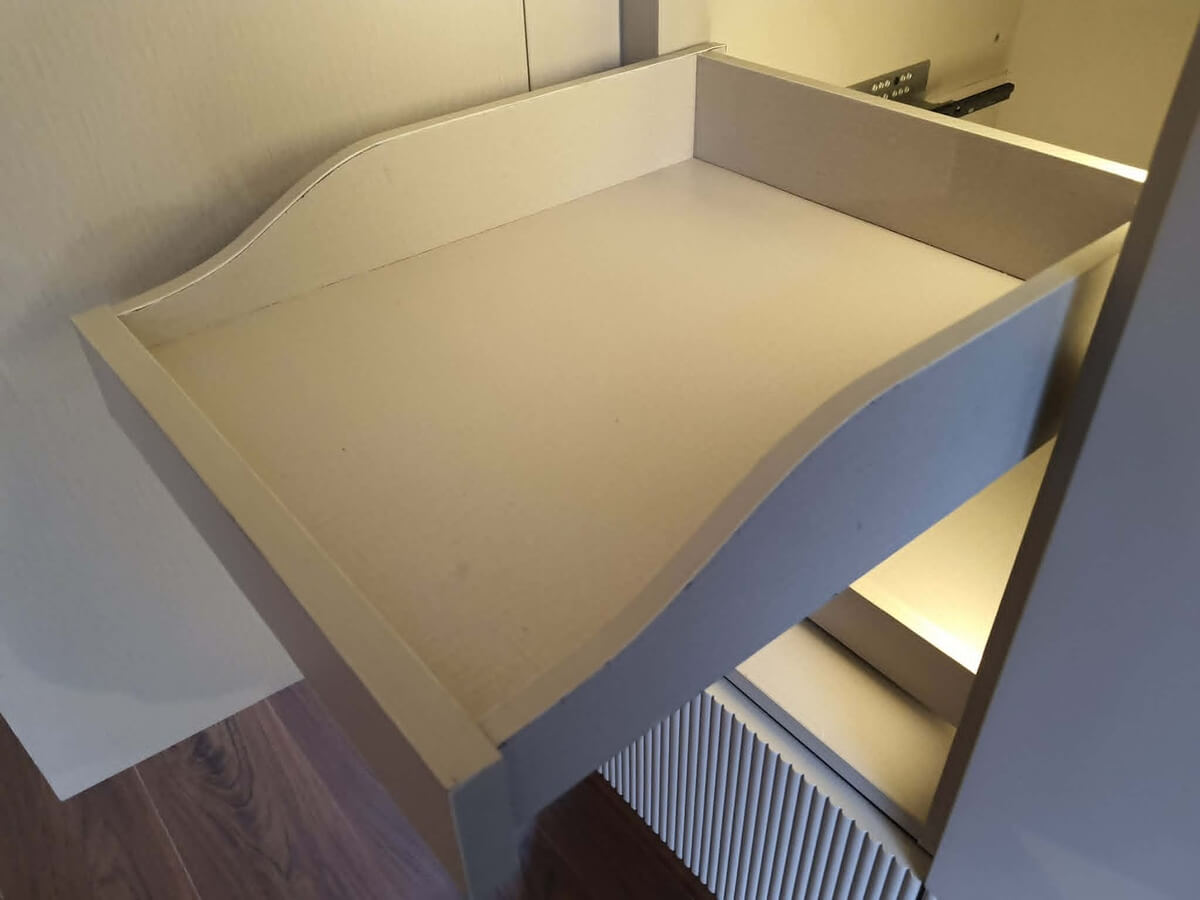
A furniture designer determines: exactly how those 10 feet are subdivided. What happens in every drawer and hanging zone. What board is structural. How the shutter is constructed. How much usable depth remains after the door and hardware. Where lighting sits inside. How corners work. What happens to dead storage. Which accessories are genuinely useful. How it is manufactured. And how it will be installed.
That one distinction separates the two disciplines.
What does a furniture designer do?
A furniture designer starts where the architecture ends.
The walls are done. The floor is done. The electrical is done. Now — what fills the room, and how does it serve the person who lives there?
- Wardrobes designed around your clothes, bags, shoes, accessories — not around a template
- Kitchens designed around how you cook — bulk storage, spice systems, utensil choreography
- Entertainment units, bars, dining buffets, study units, dressing tables — each piece custom
- Material specification — which board is structural, which is decorative, what hardware goes where, what finish lasts
- Factory manufacturing — the furniture designer controls the facility, the process, the quality
- Installation — the same team that built it, installs it
Furniture occupies roughly 70 to 80 percent of your home in terms of volume. It also consumes 70 to 80 percent of the interiors budget. If the priority is furniture — and for most Gurgaon luxury apartments, it is — then the person designing the furniture should be a specialist, not someone handling it as one task among twenty.
A furniture designer also goes deeper than just furniture. They conduct what I call a Design30 lifestyle audit — a structured inventory of how you live, what you own, how your mornings work, what you store in bulk, what passions and hobbies define your current life, what makes you feel your best when you open your wardrobe.
Modern lifestyles have evolved enormously. The travel, the socialising, the fitness routines, the hobbies, the collections — all of this needs to reflect back into your storage and furniture. A furniture designer designs for the life you live today, not the life the catalogue assumed you live.
The word "custom" causes a lot of confusion
When a homeowner hears "custom wardrobe," they assume someone designed it around them. But there are several levels of customisation:
- Off-the-shelf: standard product, no changes
- Modular adjusted: standard modules resized to fit your wall
- Customised finishes: your choice of colour, handle, and veneer from a shade card
- Custom-designed: drawn from scratch around your space
- Commissioned furniture: designed around your lifestyle, manufactured in a controlled facility, every detail specified by the designer
Changing the dimensions of a standard module does not mean the furniture was designed around you. That distinction — between customised and commissioned — is the difference between furniture that fits your wall and furniture that fits your life.
Who owns which decisions?
This is where confusion turns expensive.
An interior designer typically owns: wall layout, electrical/plumbing, ceiling and lighting, flooring and wall finishes, overall material palette, furniture placement in the room.
A furniture designer typically owns: wardrobe and kitchen internal architecture, material construction and board specification, hardware selection, factory manufacturing quality, storage and lifestyle analysis, furniture engineering, and installation.
The overlap: both care about how the furniture looks in the room. Both think about proportions. Both work with finishes.
The gap: when the interior designer specifies "soft-close wardrobe" and the furniture manufacturer uses side-mounted channels because nobody specified Quadro — that gap is the furniture designer's territory. No interior designer working on twenty decisions simultaneously will catch every hardware specification. A furniture specialist will — because that is their only job.
When you need an interior designer
- Building from scratch — walls, ceilings, floors, the entire environment
- Electrical and plumbing need redesigning
- You want the apartment designed as one cohesive visual language
- You need someone to coordinate 10 different contractors and trades
When you need a furniture designer
- Your apartment is architecturally ready — walls done, floors done, painting done — and you need furniture that does not just fill the space but serves your daily life
- You want wardrobes and kitchens designed from the inside out — starting with what you own, not with a catalogue template
- You want to specify the board, verify the cross-section, visit the facility where your furniture is being built
- You want accessories that make your mornings genuinely easier — not accessories that look impressive in a showroom
- You care about how the wardrobe functions at 6 AM as much as how it looks at a dinner party
- The furniture itself is a major part of the room's architecture — full-height wardrobes, built-in entertainment walls, kitchen cabinetry that defines the space
A lifestyle storage designer goes one step further: the Design30 audit identifies the 30% of storage volume most homes waste, and designs it back — before a single board is ordered.
Can you hire both?
Yes — and it is often the strongest approach.
Why it works:
Interior design operates at the room-and-home scale. Furniture design operates at the object-and-system scale. A 7,000-square-foot apartment and a 10-foot wardrobe are different design problems. Both need their own expertise.
Furniture affects architecture — and architecture affects furniture. A wardrobe affects electrical points, lighting, skirting, AC ventilation, wall treatment, and circulation. A kitchen affects plumbing, electrical load, chimney ducting, flooring, and ceiling treatment. The two designers should not work in isolation. The ideal relationship is collaborative — especially before services and layouts are frozen.
And there is a practical truth: an interior designer managing an entire home may be responsible for hundreds of decisions. A specialist furniture designer can spend dedicated time on one category of problem — how should this wardrobe work for this specific person? — and produce a result that a multi-tasking coordinator cannot match.
You do not need to replace an excellent interior designer to get better furniture. You can bring in a furniture specialist for the furniture scope. That makes the proposition additive, not adversarial.
When hiring both is NOT necessary
For a smaller project with straightforward furniture needs — standard rooms, no unusual dimensions, no complex storage requirements — one competent interior designer can manage everything.
Not every home needs two designers. But the more complex, personalised, and furniture-led the project becomes, the more valuable specialisation becomes.
Five questions to diagnose what you need
- Are walls, ceilings, and services still being designed? Interior designer.
- Is the apartment already settled and you need furniture? Furniture designer is the more relevant specialist.
- Is your main concern how the furniture looks — or how it stores and functions? The latter points toward furniture design.
- Do you need catalogue furniture or pieces engineered around your life? Engineered = furniture designer.
- Do you already have an interior designer you trust? Keep them. Add a furniture specialist for the furniture scope.
Read next
Frequently Asked Questions
What is the difference between an interior designer and a furniture designer?
Do I need an interior designer to get custom furniture in Gurgaon?
How do I choose between an interior designer and a furniture designer?
Can an interior designer and furniture designer work together?
What is a lifestyle storage designer?
Is a furniture designer more expensive than an interior designer?
What is the difference between customised and commissioned furniture?
What should I look for in a furniture designer in Gurgaon?
If you are unsure which specialist your project needs, start with the furniture questions — that is where most homes are won or lost. Reach out with your questions or list of topics you'd like covered next!
Talk to Himani on WhatsApp