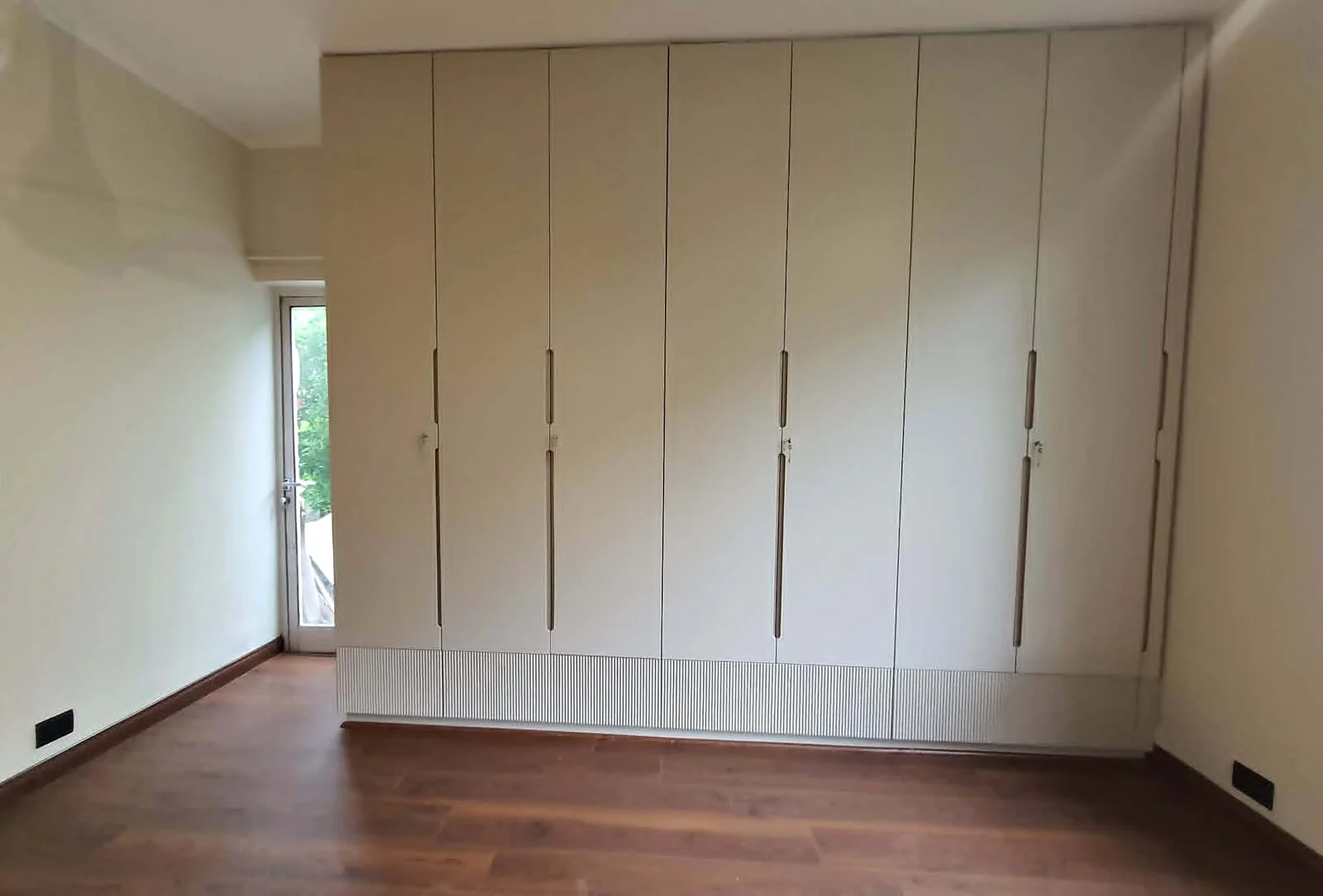
How Deep Should a Wardrobe Be? The Dimension Nobody Asks About
Width gets measured. Height gets discussed. Depth quietly decides whether you can ever find anything.
Every wardrobe conversation I hear in Gurgaon is about width, height and finish.
Short answer
About 24 inches including the shutters — the depth where a shirt on a hanger hangs straight. Shallower crushes shoulders; deeper grows a back row you never reach. Keep the depth standard and let pull-outs, drawers and pull-down rails bring the back to you.
Almost nobody asks about depth. And depth is the dimension that decides whether your wardrobe is a place you reach into — or a place things disappear.
Start with the hanger
A shirt on a hanger needs roughly 20 to 22 inches of clear space inside the wardrobe to hang straight. Add the shutter, the back panel and the hardware, and you arrive at the depth most wardrobes are planned around — about 24 inches including the shutters.
That is my standard too. Not because it is a rule, but because it is the depth where hanging works without wasting anything.
Too shallow
- Shirts hang at an angle
- Shoulders get crushed against the shutter
- Doors rub against sleeves and never quite close cleanly
- Coats and heavier garments simply do not fit
Too deep
This is the more common mistake in large homes, where "deeper means more storage" sounds logical.
- Fixed shelves grow a second row at the back
- The second row becomes dead storage
- You buy a new sweater because you cannot see the one you already own
Extra depth that you cannot reach is not extra storage. It is a hiding place.
The real answer: depth that comes to you
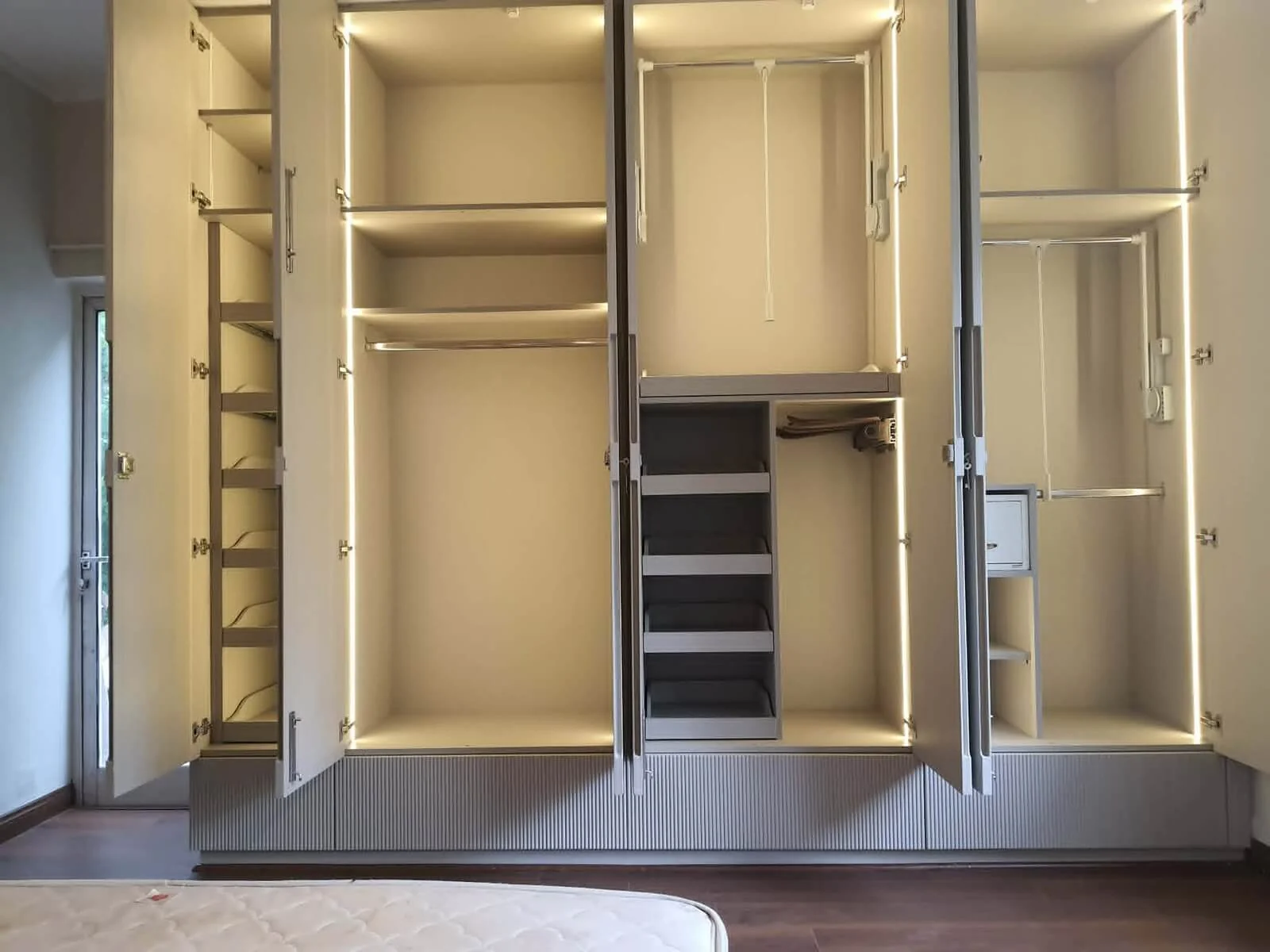
I keep the depth standard and let the internals do the work.
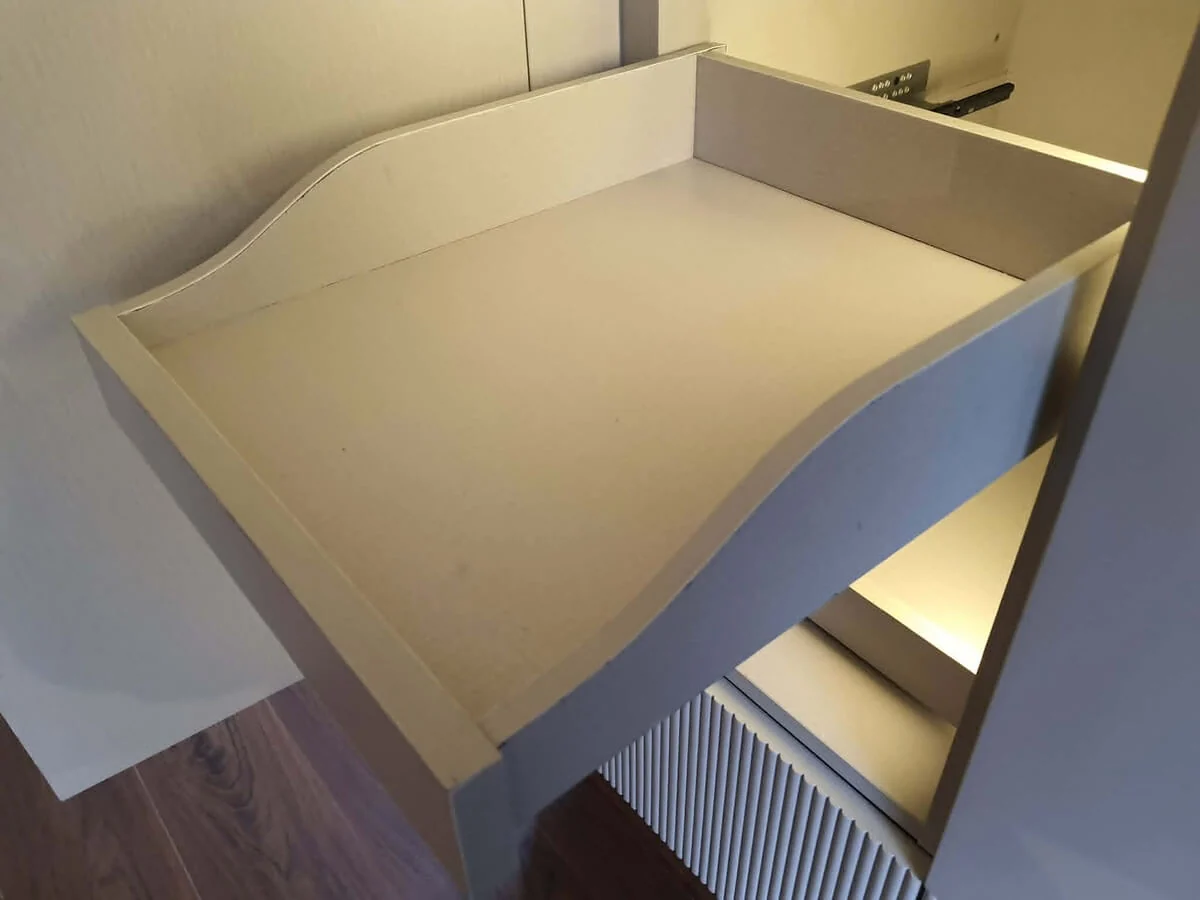
- Pull-out shelves bring the back of the shelf to the front
- Drawers show their full contents when they open
- Pull-out trays keep shoes visible in one glance
- Garment pull-downs bring the top zone to arm height
Depth is only wasted if it never moves. Once it moves, every inch of it is prime real estate. That is a large part of how Design30 recovers volume — the Rule of 30 says most finished wardrobes waste around 30% of their space, and a lot of it sits at the back.
Sliding doors eat depth
Sliding systems need room for their tracks and for panels that pass one another. That takes a few inches of depth — either added to the wardrobe or taken from the inside.
Hinged shutters don't consume depth the same way. They need something else instead: room in front to swing open. (More on that choice in Hinged vs Sliding Wardrobe Doors.)
Walk-ins play by slightly different rules
With no shutters, open folded storage in a walk-in can sometimes sit a little shallower. Hanging still needs its full depth. And the aisle between the two sides matters as much as either side.
Don't forget the depth in front of the wardrobe
A wardrobe's usable depth continues into the room. You need enough space to open a drawer fully and still stand in front of it. Too little, and the bed, the bedside table or the door starts deciding how you dress.
Five questions before you approve a wardrobe depth
- Will a hanger with a jacket fit without touching the shutter?
- What happens at the back of every fixed shelf?
- Which sections pull out?
- If the doors slide, where did the track depth come from?
- Can I open the lowest drawer fully and stand in front of it?
Read next
Frequently Asked Questions
What is the standard depth of a wardrobe?
Is a deeper wardrobe better?
How do pull-outs help wardrobe depth?
Do sliding wardrobes need more depth?
How much space should be left in front of a wardrobe?
If this raised more questions than it answered — that's the beginning of a great conversation. Reach out with your questions or list of topics you'd like covered next!
Talk to Himani on WhatsApp